
Every quarter, another slide deck announces that the company is "doing AEO." Someone runs a handful of prompts in ChatGPT. A screenshot lands in Slack. A workshop is booked. Then nothing—the pilot never becomes a program.
The pilots that fail are usually not failing because the channel is fake. They fail because they were designed like a lab tour, not like a capability.
What is the lab tour problem?
Lab tours are useful. They create urgency. They also share a fatal design:
| Lab-tour habit | Why it kills the program |
|---|---|
| Sample size of one afternoon | Three prompts are anecdotes with good lighting, not a measurement system |
| No owner after the workshop | SEO owns rankings, PR owns reputation, brand owns narrative—AEO sits in the gap |
| Success = "we noticed something" | Noticing is not a KPI; share of voice over a fixed prompt set is |
| No link to decisions | If the insight cannot change content briefs, product pages, or partner PR, it was entertainment |
This is the same pattern that killed early "AI pilots" across enterprises: impressive demos, unclear operating models. Answer engines simply make the failure more public, because anyone with a login can recreate the demo.
What does AEO actually ask of an organization?
Answer Engine Optimization is not a new keyword tool. It is a claim about how buyers discover brands when the interface is a synthesized answer instead of a ranked list.
That claim forces three uncomfortable questions:
- Which questions matter? Not "brand name + review." The category prompts people ask when they are choosing: best X for Y, X vs Z, alternatives to X.
- Which sources do models trust when they answer those questions? Often not your homepage. Frequently third-party roundups, documentation, encyclopedic pages, forums, and news.
- Who is responsible when the answer is wrong or incomplete about you? If the answer is "marketing eventually," you do not have AEO. You have hope.
Teams that leave the lab treat those questions as recurring work, not a one-off audit.
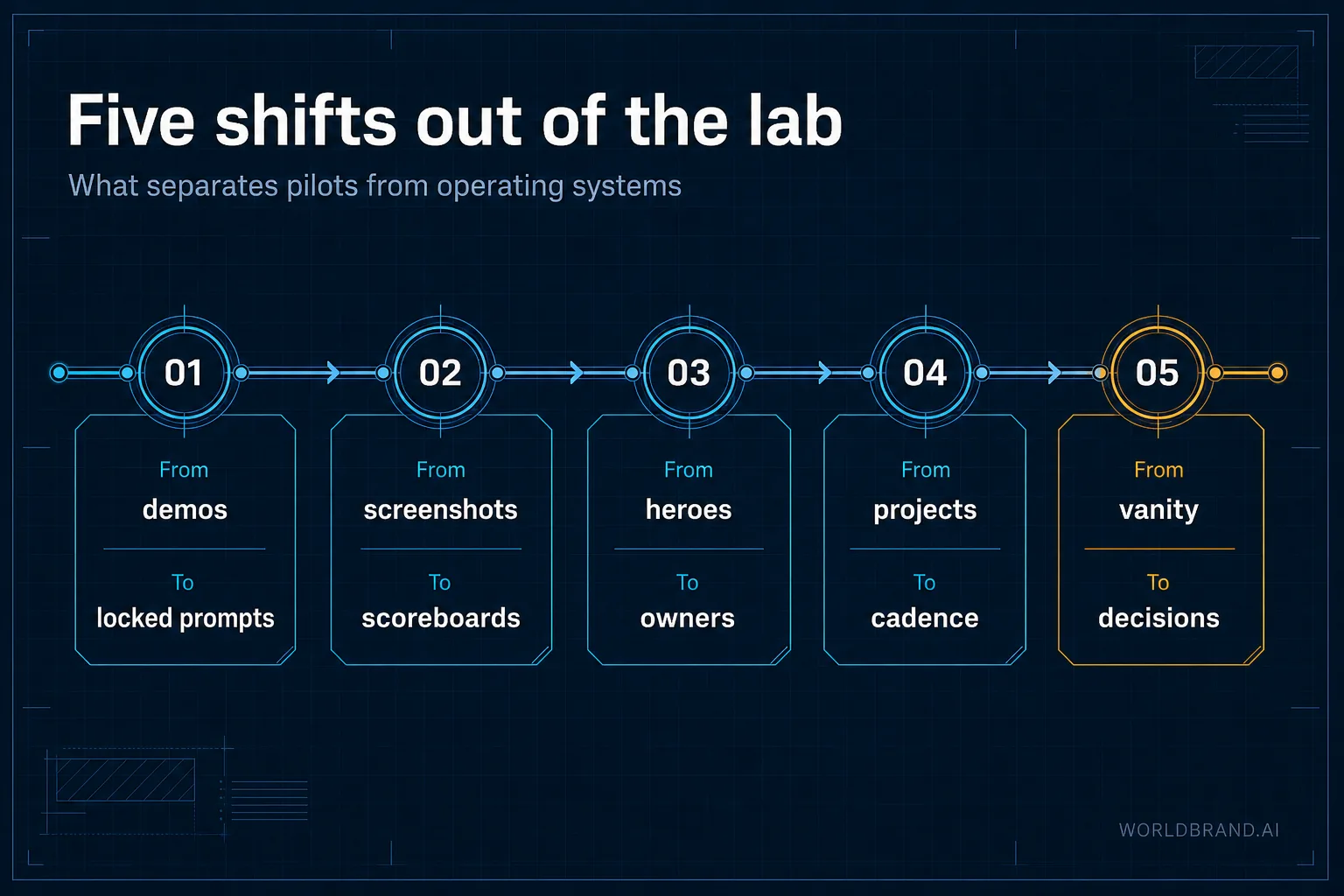
What five shifts move pilots to systems?
1. From screenshots to a prompt portfolio
Lock a portfolio of prompts that map to real buying journeys. Keep it stable enough to trend. Refresh it when the market language changes—not when someone is bored.
A good portfolio mixes:
- Category discovery ("best … for …")
- Comparison ("X vs Y")
- Problem-solution ("how to … without …")
- Trust and risk ("is X safe / reliable / worth it")
2. From vibes to repeatable metrics
Track mention rate, competitive share of voice, sentiment framing, and—when available—cited sources. Run the same portfolio on a cadence. One dramatic week means little. Twelve quiet weeks mean everything.
3. From "content ideas" to source repair
If models cite a stale review site more than your product docs, the fix is not another blog post about your values. It is repairing the evidence graph: accurate specs, current pricing language, clear category positioning, third-party facts that match first-party truth.
4. From orphan project to named owner
AEO needs a DRI who can convene SEO, content, PR, and product marketing. Not a committee. A person who can say: this prompt set is canonical; this gap is owned; this change ships by Friday.
5. From novelty budget to operating budget
If AEO only exists when a consultant is in the room, it will die when the invoice ends. The cheapest durable version is boring: a monthly measurement ritual, a backlog of source fixes, and a rule that category pages answer the question in the first screen.
Why should leadership care now?
Buyers are not waiting for your roadmap. They are already asking assistants for shortlists. If your brand is absent, the assistant still answers—with someone else. That is not a future risk. It is a present distribution cost you are not measuring.
The labs that escape the lab do something unglamorous: they stop performing AI awareness and start operating brand visibility under a new interface.
FAQ
How do we attach AEO to meetings we already run?
Steal a recurring block from an existing ops or growth ritual—do not create a floating "AEO council." Put the locked prompt scoreboard first on the agenda and cap WIP so the hour produces source-repair tickets, not another readout deck.
What should we stop funding while the pilot is still a lab tour?
Novelty budget for consultant-led demos without a named DRI, canonical prompt set, or repair backlog. If AEO only exists when the invoice is open, it will die when the invoice closes.
How much open work is too much for an early program?
Many teams cap evidence-repair WIP at three to five active items. An endless backlog with no ship dates is the same failure mode as a screenshot with no owner—just in slow motion.
What is the leadership anti-pattern that keeps pilots in the lab?
Rewarding "we checked AI search" activity over outcomes on unbranded category prompts. If the only artifact is a deck with no owners or due dates, you are still touring the lab.
Where BrandAI fits when pilots graduate
- BrandAEO — locked prompt portfolio, mention rate, SOV, and citation trail across engines
- Brand Hub — investigation surface while you diagnose source gaps
- BrandWiki — encyclopedic / reference hygiene for the evidence graph
- BrandAI — draft repair briefs and leadership notes faster once the operating cadence exists
- BrandSight / BrandValue — structural and equity context so AEO work is not orphaned from brand strategy
Bottom line
Screenshots are how you start. Systems are how you stay in the answer.