
Search used to be a list. AI search is an editorial decision dressed as fluency.
In the citation economy, the scarce resource is not attention on a results page—it is inclusion inside an answer that pretends, confidently, to already know who matters.
When someone asks an assistant for the best tools in a category, the model does not politely return page two. It compresses the web into a shortlist, often with a few citations as moral cover. Those mentions are scarce. Scarcity creates an economy—whether marketers admit it or not.
Call it the citation economy: the informal market for being named, framed, and sourced inside machine-written answers.
Are mentions the new rankings?
A classic ranking has structure: positions, titles, URLs, ads above the fold. An AI answer has soft structure: which brands appear, in what order, with what adjectives, and which URLs get the footnote.
That softness is why teams misread the channel.
- Showing up once in a chat is not "ranking #1."
- Being described as "popular but pricey" is not neutral visibility.
- A citation to a three-year-old roundup is not endorsement of your current product.
If you still score success the way you scored SEO—impressions and average position—you will optimize the wrong artifact.
What are models optimizing for?
Large language models are not your brand committee. In answer mode, they typically optimize for something closer to:
| Models tend to optimize for | Models rarely optimize for |
|---|---|
| Plausible completeness — cover the category without sounding ignorant | Your paid media plan |
| Consensus — prefer names that appear across many independent sources | Your latest campaign slogan |
| Recency when available — especially in tools that browse | The PDF brand book you emailed last year |
| Safety and blandness — avoid confident claims that are easy to falsify | One-off messaging without open-web corroboration |
So the brands that win mentions tend to win the evidence war, not the messaging war. Messaging still matters—once you are in the room. First you have to be invited by the data the model trusts.
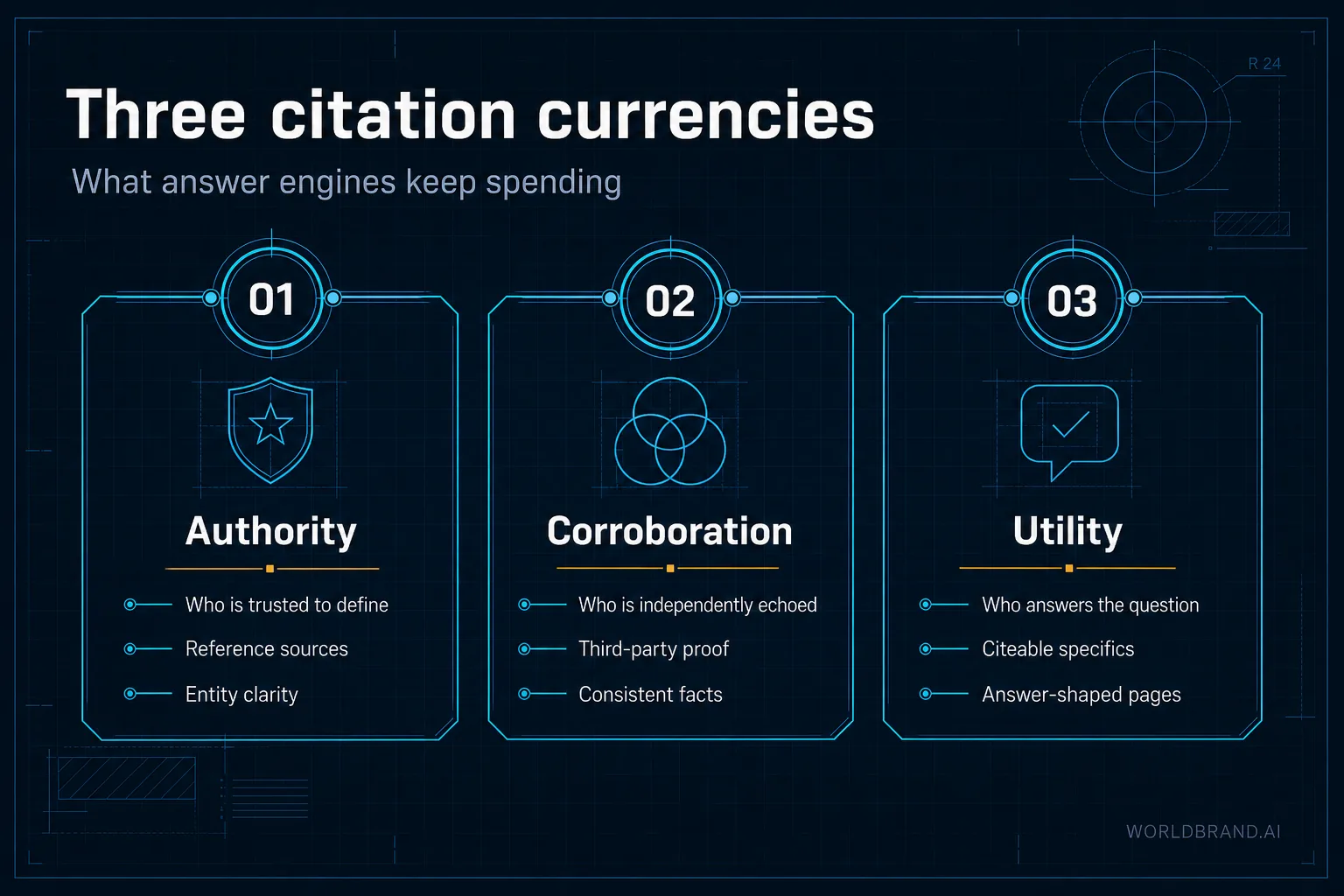
What are the three currencies of the citation economy?
1. Corroboration
One glowing homepage claim is weak. The same claim repeated, with consistent naming, across documentation, reputable journalism, analyst notes, and community discussion is strong. Models are pattern matchers. Corroboration is the pattern.
2. Citeability
Pages that answer a discrete question with clear facts travel farther than pages that sell a lifestyle. Specs, comparisons, definitions, timelines, and "who it's for / who it's not for" sections are citeable. Vague manifesto copy is not.
3. Correctability
When your public facts conflict—old pricing on a review site, a wrong founding year on Wikipedia, a deprecated feature still listed in a roundup—you do not just confuse humans. You give the model reasons to hedge, omit, or prefer a cleaner competitor narrative.
How does selection usually fail brands?
| Failure mode | What it looks like |
|---|---|
| Category invisibility | Internal product language; buyers and models use different nouns—you are hard to retrieve as a candidate |
| Evidence concentration | All proof lives behind gated PDFs or login walls; assistants lean on what is easy to fetch and quote |
| Competitor gravity | A rival has years of comparison pages, integration docs, and third-party tutorials; your one viral launch post does not rewrite that prior overnight |
| Sentiment leakage | You get mentioned—and the framing is "legacy," "expensive," or "complicated"; in a shortlist of three, framing is the ranking |
Playing the economy without becoming cynical
The citation economy rewards substance that can be checked. That is good news for teams tired of empty thought leadership. It is bad news for teams whose only plan is to prompt-inject their way into answers.
A practical posture:
- Inventory the questions that create shortlists in your category.
- Map the sources that already shape those answers—then improve or counter them with better public facts.
- Write for extraction: lead with the answer, support with evidence, date the claims.
- Treat consistency as infrastructure: names, category labels, and product facts should match across owned and earned surfaces.
- Measure mentions as a portfolio, not as a vibe check after lunch.
The quiet shift in brand strategy
For twenty years, brand strategy often meant controlling the story you told. In AI search, brand strategy increasingly means shaping the story others tell when a machine has to be brief.
You still need a point of view. You still need creative. But creative that never becomes corroboration will not enter the shortlist.
FAQ
Who should own citation repair when facts conflict?
Assign a fact owner—usually product marketing or brand ops—with SLA for public contradictions (pricing, specs, category nouns). PR owns earned corroboration; web owns citeable pages. AEO leads measure whether repairs show up in prompt results—not whether someone filed a ticket.
What should teams stop optimizing for?
Stop treating a single chat appearance as "ranking #1" or optimizing for impressions and average position. Stop prompt-injecting or campaign-slogan pushing when the underlying evidence graph is thin, gated, or contradictory.
How do we attach citation work to existing rituals?
Wire mention-portfolio review into the weekly AEO rhythm—same locked prompts, same peer set—and translate citation churn into tickets with owners and due dates. See From Snapshot to Operating Rhythm for the cadence.
What is the most common anti-pattern in citation strategy?
Chasing domain authority folklore while ignoring citeability and correctability. A high-DA page that answers nothing discrete, or public facts that contradict each other, will not earn repeatable mentions no matter how polished the homepage manifesto reads.
Where BrandAI fits
- BrandAEO — mention and citation portfolio across engines on a locked prompt set
- Brand Hub — inspect brand context while chasing URL-level citation stories
- BrandWiki — encyclopedic and reference hygiene when corroboration depends on third-party clarity
In the citation economy, brands that win will look boring in their evidence rituals—and sharp in their answers.